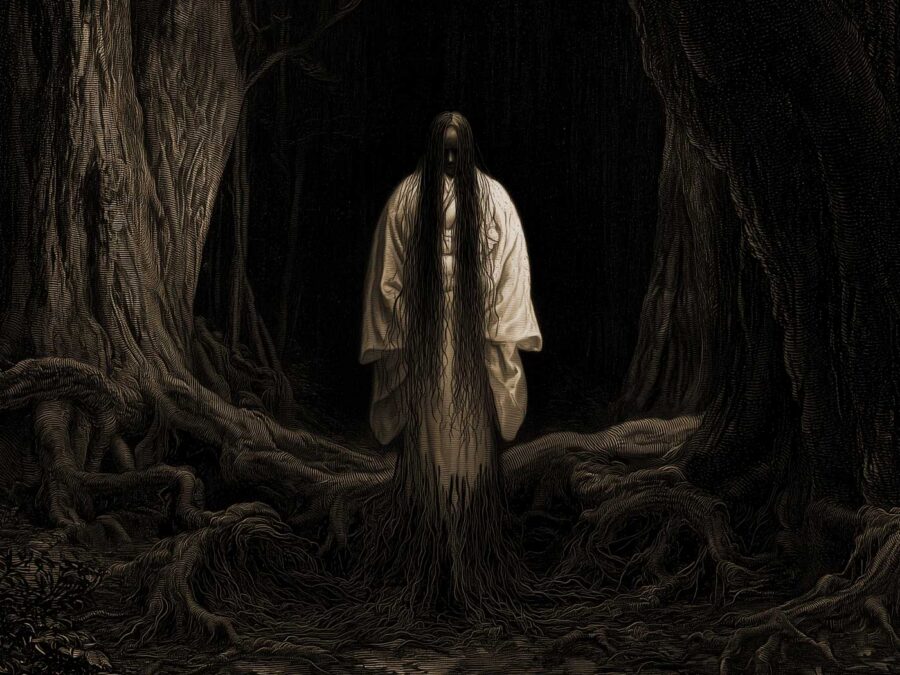
In my opening post about my new project, Sister Legends, I mentioned writing up some explainers on past videos. My idea around this was simple, detail how I went about researching and creating each pair of videos partly to help others that might want to go down the path, and partly to keep a record for myself of what had come before.
I had intended to go back and start at the beginning, but this week was an interesting one in the Sister Legends saga, so I changed my mind and decided to start in the present…I’ll go back into the past later.
As I said, when I first hit upon the idea…long before the project had a name…I was simply going to do a legend or myth or piece of folklore from each of the 50 United States. But, that world seemed saturated when I dug into it, and also a bit limited in scope. I then thought I would pair a US legend with a World legend, searching for similarities, but quickly realize that was centering the USA and quite provincial, if not downright colonial. So I settled on the idea of focusing on the underlying concept of each legend, regardless of location. Focus on what was similar, despite the differences in culture.
Along the way I created a rather long list of world legends and folklore…Google is of course awash with folklore subject matter, as it is in pretty much every subject matter.
So, pretty early on I settled on the pairing of “Stull Cemetery” for episode 5A and “Aokigahara (the Suicide Forest)” for episode 5B.
It seemed like a good match. Two spots on the planet that seemed to have a tear in the veil between the land of the living and the land of the dead.
Now keep in mind, though I may use AI for some things, researching is something I do myself, long before AI is even involved. I want to make sure the facts and references are all my own, found and attributed by me. We’ve all heard the stories about AI being used in places it shouldn’t be, and problems being caused when AI “hallucinations” (the industry is reluctant to call them ‘errors’) cite facts, events and even people who do not really exist.
My way around this has been to do the research myself, learn about the subject, create a long document with proper citations, and then use AI for the thing it does best: analyzing loads of data. I’ll let it take my many pages of notes and links and tidbits and turn it into a cleaner framework and timeline. Along the way, the underlying story jumps out at me, and I have a deeper understanding of the subject, while AI helps with grunt work and organization.
And that’s how this last week started: I was deep into research on Stull Cemetery. At first, it was all very compelling…stories of hauntings, Satanic rites and a ‘gateway to Hell’! I just needed a bit more history to flesh it all out…and that’s when it started falling apart. As I’m dug into it, I found that the Stull Cemetery legend is based on an already debunked college newspaper story from 1974. A newspaper story written as fiction, for the Halloween edition, that due to a scheduling issue was actually printed well away from Halloween. Without the context of the holiday, people took it as “fact”. And the legend was born.
And it seems the residents of the actual Kansas town of Stull wish folks would STOP talking about it, because it has led to vandalism at the cemetery itself. This tiny town had had thrill seekers and ghost chasers descend on their area for decades looking for evidence of a fiction, and leaving desecrated memorials, trash and such in their wake. The cemetery is now closed to the public, fenced off and patrolled by local police.
I realized quickly that episode “5A – Stull Cemetery” was a dud. And I didn’t want my little video to lead to someone’s beloved family members grave being vandalized, all to perpetuate a known lie.
So I pivoted, and decided that Aokigahara would be my episode 5A, and I’d find something else to fill out the pairing. I eventually settled on, The French forest of Fontainebleau and the legend of the Black Hunt…but that’s a story for next time.
I then dove into Aokigahara and its history with earnest.
At first, I began feeling a lot of what I felt about Stull Cemetery. Thinking, do I REALLY want to do this?
The issue is its nickname: The Suicide Forest.
The fact is, many people actually DO kill themselves in this forest every year. So much so that Japanese authorities have placed signage at the entrances offering help and support, in hopes of staving off the practice. REAL people have come to this forest in the deepest kind of despair and some of them have not come back. And those people have families and loved ones that need to be respected.
I was wary and approached the deeper research with the idea that I needed it to be about everything BUT the suicides. I needed the story of this haunting eerie place to be more than just exploitation. Too many times in the past, these poor folks have had their grief made into a punchline for clicks and content.
I’m not that kind of person.
So I continued to dig. I fell down a rabbit hole of Japanese myth, belief and history.
I quickly realized that this forest has been spooky to the people of Japan since long before the suicides started in the 1950s. Part of this spookiness is attributed to the unique makeup of the forest itself and part of it due to Japanese spiritual and cultural beliefs going back centuries.
Aokigahara Forest, whose name translates roughly to “Plain/Sea of Blue-Green Trees” is a little over 1,160 years old. A major volcanic eruption in 864 CE sent lava pouring down the side of Mount Fuji, covering everything in its path in an area of roughly 30-35 square kilometers. After the lava hardened, dense trees, moss and other plants began to grow over the dense rocky terrain that was left behind.
This created an environment that was unique, as in some places the topsoil is only centimeters thick. So tree roots have to grow out horizontally, rather than vertically, as they cannot penetrate the lava rock. So the legs of trees spread out laterally, across the surface of the rock, gripping it, while the trunks grow skyward. The resulting jumble of roots, when combined with the moss that grows so freely, creates a ground surface that ripples out in every direction, creating strange forms, that some witnesses say can resemble human limbs or bodies. The resulting canopy overhead is so dense, the sunlight barely penetrates, making some areas appear to be in perpetual twilight.
The lava rock underneath is dense and porous, uneven and cavernous. It is riddled with pockets and caves that are so insulated they are filled with ice even at the height of summer. The rock absorbs sound. It is said that if you walk a hundred meters off the trail, letting the tree trunks and canopy envelop you that the world outside goes silent.
This is off-putting enough before you realize that the iron content in the lava rock also throws off compasses. The Japan Ground Self-Defense Force has run navigation training in this forest since 1956, specifically because of what the terrain does to orientation.
This forest is spooky without a single ghost story added to it.
But then I found the stories about “ubasute”, and things got decidedly creepier.
The Reality or Myth of Ubasute
Ubasute (pronounced ‘oo-bah-sue-tay’) is a bit of controversial subject in Japanese history…some historians claim it either never happened, or never happened widely. The thing is, it is documented across Japanese folklore, and specifically associated with Aokigahara into the 19th century. So even if it IS only an urban legend, it is something that has been believed in Japanese folklore across several centuries.
In lean times or times of famine, ubasute was the practice where families would take the old or infirm, that they could no longer care for, into the wilderness and leave them. And it is assumed, in the way that the very “Japanese” culture functions, that the old and infirm knew this was happening and accepted their fate for the greater good of the family. I came upon several references to an ancient Buddhist poem, sometimes attributed to Aokigahara forest sometimes not, of a man carrying his elderly mother on his back up a hill. Along the way, she reaches out and snaps twigs from the trees, scattering the twig remains behind them as they go. When her son asks why she is doing this, she answers “So that you may find your way home more easily.”
This woman is leaving a trail of safety for the child that is abandoning her to die.
That struck me like a kick to the chest.
When combined with the history of the yurei in Japanese legend, I began to realize other reasons Aokigahara could be full of hauntings. Haunting that predate the modern suicide issue by generations of generations.
The Yurei
If you have seen modern Japanese horror films such as “Ju-On” (remade in America as “The Grudge”) then the concept of yurei is known to you, even if the term is not. In Japanese folklore, we all have a soul or spirit, called a “reikon” (pronounced “ray-cone”). When we die, this reikon leaves our body and goes on to whatever is next. Upon death, certain rites must be performed, certain respect given, for that reikon to move on. If this is done, that reikon becomes a protector of the family, that returns every August during the Festival of Obon to receive thanks.
If these rites are not performed, if this respect is not given, or if the person died with powerful emotions like as a desire for revenge, love, jealousy, hatred or deep sorrow, they become a yurei, a spirit tied to the location of their death until the rite are performed. And the power of these spirits was in inverse proportion to the power they had in life. An angry peasant who became a yurei was much more dangerous than a rich noble with the same fate.
Throughout Japanese history yurei have been blamed for everything from simple hauntings to earthquakes and typhoons.
You can laugh all you want at this idea, but, it was taken VERY seriously by the Japanese people. So much so, that during the the Heian period (794–1185 CE), the crown bowed to practitioners of Goryō Shinko — the Religion of Ghosts. To calm spirits, official rituals were performed to posthumously raise the dead in rank and title before they were enshrined as kami, protector spirits in Shinto shrines. Take note of the dates above…and notice this belief and practice predates the eruption of Mount Fuji that created the Aokigahara forest.
Yurei existed before the forest.
Yurei existed before the practice of ubasute became a factor in the forest.
Aokigahara Forest is possibly filled with an abundance of yurei spirits. Trapped. Tethered. And unable to move on.
There was the hook I needed.
Making It All Into Something
Now that my research was done…it took you a couple minutes to read what it took me a few days to compile…I set about creating a cohesive script. The AI had helped me compile all my data, which I worked into a story timeline and then further refined to make it fit the time.
I decided I wanted to do the YouTube version first, then the TikTok and Instagram versions later which was the opposite of what I had been doing. This would allow the narrative to have more heft, and allow certain plot points to resonate with me, letting me know what could be cut down later in the shorter TT and IG versions. I typically shoot for 8 to 10 minutes of run time, but my first draft of this one was well over 20.
With some editing and cutting, I got it down to 17, and then reworked it again and got it under 16. I decided to only touch on the “suicide” topic, because, again, I’m not looking to exploit. Then again, I can’t avoid it altogether, because that is the modern framing of the forest. So I mention it only briefly, and the word “suicide” is only said once.
I also decided I should add a PSA stating “If you or someone you know needs help, the 988 Suicide and Crisis Lifeline is available by call or text, 24 hours a day” for anyone needing help during that section. Because it’s the right thing to do.
I then feed my script, in chunks, into another AI for the voiceover. As I’ve already mentioned, this is another good use of AI, as it allows for consistency and an even tone across all of the videos.
I then create the images, which is way more time consuming than you would think. AI images are a chore when you’re an actual artist. Even more so when you have my personality. My brain is permanently stuck on “fuck it! I’ll do it myself!” mode, so it is very rare that an AI image fits exactly what I want to see. (If I had the time, I’d draw it ALL myself….but then I’d release one of these every six months).
As I said previously, the visual idea of “Sister Legends” is that I am sharing old knowledge, gleaned from old sources, so I want my images to look like illustrations from a “18th or 19th century natural history book”. The only source artists I mention by name in my prompts are Gustave Doré and Albrecht Dürer, and then only to get a particular etched style.
The images I get back rarely fit exactly what I want, so I often make dozens, and then composite them in Photoshop until they fit what I need. “I want this tree and that rock and this background…” I often say, and the etching style allows me to collage them all together nearly seamlessly to create the images I end up using. I typically end up with multiple versions of each edited image as well, and decide when editing which works best.
If you see 16-18 images in a video, just know that there are 20 on the cutting room floor, and they were all Frankensteined together from 100 others.
I then take all of these elements in Premiere and compile them, audio, visuals and effects, piece by piece until I reach a finished product to upload. Often popping back into Photoshop to tweak images or colors, or splicing the audio to fit what I need.
I truly don’t know how folks just use AI stuff as is.
I really don’t. Maybe it’s that I can’t. I’d rather have something be a little off because I made it that way, than to just accept that this is the best an AI could give me.
I say, “Fuck it. I’ll do it myself.”
Enough talking about it. Go watch it. The link is below