There is a particular strain of horror that exists almost entirely outside the Hollywood ecosystem, which quickly draws in horror fans like myself, not just because it is bereft of the cookie cutter formulaic tropes of American horror, but also because it often takes itself more seriously. Much of Asian horror cinema is lauded for the newness of the fears, as they touch upon myths and realities that are alien to Western minds, but, they too walk a path that seems to take itself quite seriously. Horror exists. Horror is a real thing.
There are also films made in countries where the genre carries different cultural weight, where Catholic guilt is not a marketing aesthetic but an actual inheritance, and where the devil is less a special effect than a genuine theological proposition. Horror from outside of the “American system” has been producing quietly devastating work for decades, most of it unseen by English-speaking audiences who would likely find it far more disturbing than anything their own industry is currently offering.
Hellhole (2022), directed by Bartosz M. Kowalski, sits comfortably in that tradition, this is a film that earns its darkness the hard way, by believing in it. God, demons, the Devil and faith all exist in this world. These ideas are taken as table-stakes, and the narrative proceeds from there.
The setup is deceptively procedural. A young officer, Marek, arrives undercover at a remote monastery in 1987 Poland, officially to investigate the disappearance of several women who sought refuge there. What follows in the first two acts owes an obvious but well-executed debt to David Fincher, specifically the grimy, institutionalized evil of Seven, where the horror is less supernatural than systemic, embedded in the rituals and architecture of a place that has had a very long time to become wrong.
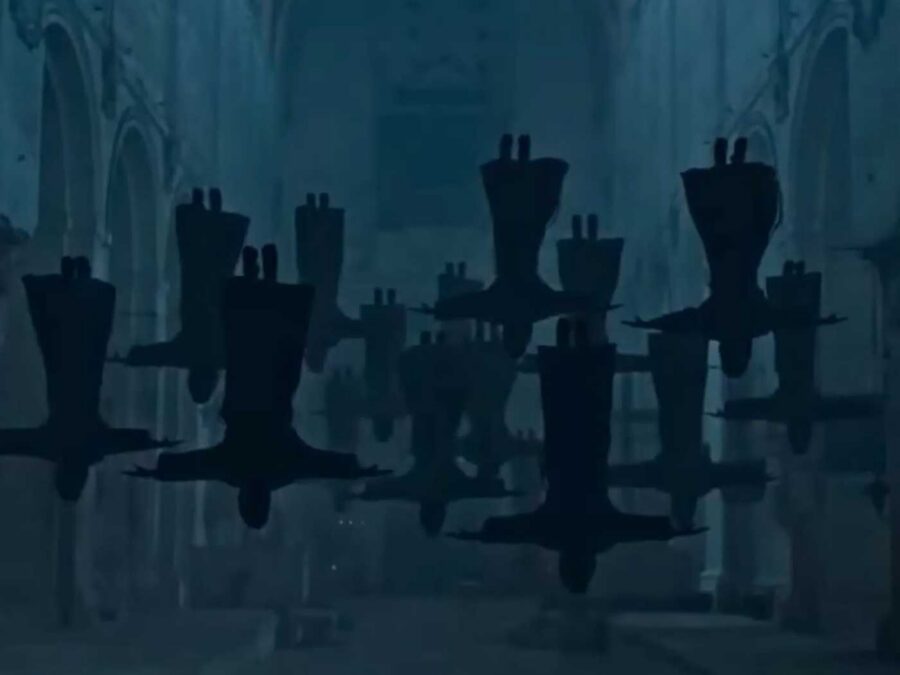
The dread and unease tickle the back of your mind almost instantly, and the setting of the old crumbling monastery, surrounded by a landscape that is either dead or neglected…or both, serves as a perfect backdrop. The monastery is beautifully realized. Cold stone, bad light, the particular silence of a place that has learned to keep secrets. Kowalski lets the dread accumulate slowly and with real discipline, trusting his location and his actors to do the work that a lesser director would outsource to a score and a jump cut.
To be clear, there are a few “jump” moments woven in, but Kowalski knows you are expecting them, so rather than using them to startle a scream out of you, they are meant to add to the heavy weight of the atmosphere. Unlike other films where the jump is set as a release to lead you into something softer, and then build to another jump, creating this almost narrative mathematic of “build, scare, release, build, scare, release”, there is no “release”. There is only “build, build, build” with the tension increasing palpably through most of the film.
You talk to the screen, you just want Marek to get the fuck out. You feel like you are trapped inside the monastery with him, and much like Marek, you aren’t sure who to trust and who not to trust. In yet another nod to the filmmakers, even when you seem to meet someone you can trust, you still give serious side eye.
And then the last fifteen minutes happen. Without going anywhere near spoiler territory, Hellhole earns its title in a way that most horror films do not: not through escalation, exactly, but through a kind of cold inevitability that calls to mind the closing frames of The Exorcist or the Turkish horror “Baskin”, less in its imagery than in its emotional register. Remember, this is a world that is fully entrenched in the conceit that it is selling.
The ending is bleak in the way that only truly committed horror can be bleak: not nihilistic for effect, but genuinely persuaded that some things cannot be fixed, that some doors, once opened, do not close. It is the kind of ending you sit with rather than discuss, which is the highest compliment I can pay a horror film. Four stars out of five — and the missing star belongs only to a mid-section that occasionally mistakes patience for inertia. The final act more than settles the debt.