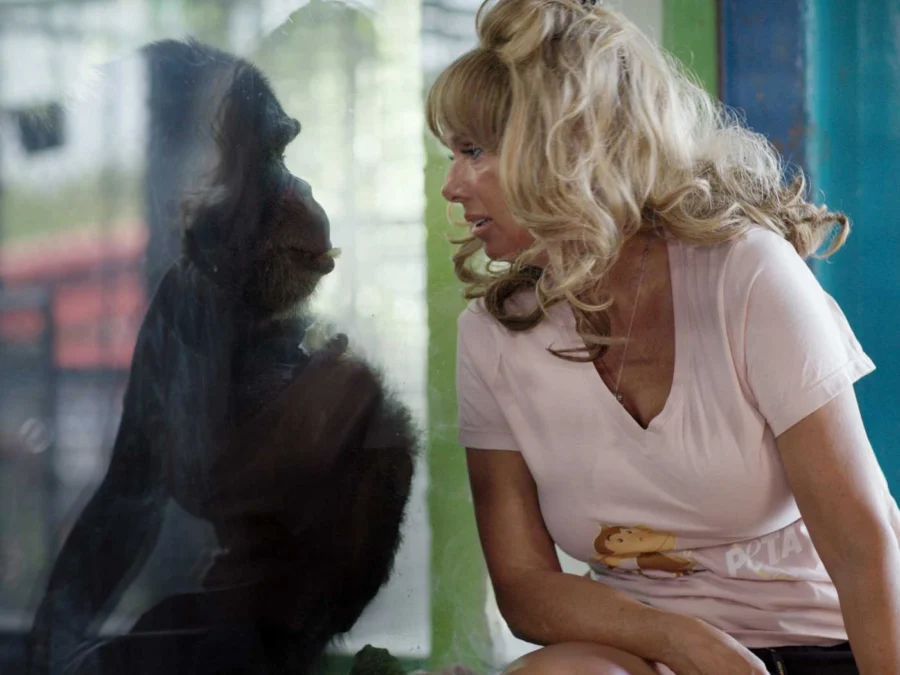
Chimp Crazy (2024, HBO Max) is the spiritual successor to Tiger King, the Netflix documentary that had all of us in a quarantined choke-hold back in 2020. The Tiger King comparisons are unavoidable, as both it and Shimp Crazy were brought to us by Eric Goode — the same man who unleashed Tiger King. Chimp Crazy is a four-part docuseries that descends into the murky world of private primate ownership with all the subtlety of a hand grenade at a dinner party.
Where Tiger King was a wild romp into a cartoonish realm we’d never inhabit, Chimp Crazy is more like a depressing fever dream you cannot look away from. At its center is Tonia Haddix, a former nurse-turned-exotic-animal-broker who refers to herself as the “Dolly Parton of chimps,” but she veers away from the world of Dolly when you get past the bottle blonde hair, and becomes a more pitiful character the deeper you dig. From the almost as orange as Donald Trump fake tan to the blacker than black eye makeup and lip injections, you quickly realize this poor woman has issues that she is clearly trying to hide behind a luminous façade. There are much deeper issues here than just wanting to be blonde, just wanting to be tanned, just wanting plump lips.
At one point this is painfully driven home when her own son says he’s never seen her love anyone more than her chimp, Tonka…not even him, her actual child. And where Joe Exotic of Tiger King came across like a carnival barker with an imagined music career and a comic book nemesis in Carol Baskin, you never got the feeling that the tigers were more than just an extension of his larger than life, albeit ill conceived, character.
With Tonia, it is clear from the outset that Tonka and the other chimps are meant to fill some void in her soul, even at the expense of the animals own well-being (she feeds them McDonalds and sports drinks for fucks sake). Tonia’s “Carol Baskin” is put forth in the shape of PETA, whom she claims has a personal vendetta against her. PETA, the law, veterinarians and others are the true villains in her eyes.
The scenes of Tonia are interspersed with stories of other chimp owners past and present, and how their tales ended in injury, tragedy, maiming and even death. As a viewer you struggle to find empathy for the chimp owners throughout the documentary, but there is very little to be found. Even Goode, the director filmmaker, seems to struggle to find somewhere to put his own compassion in his dealing with Tonia, and finds scant reasons to extend it.
Chimp Crazy actually differs in content and tone from Tiger King – it’s sad, more depressing, more pathological, less of a silly romp in the side show of the circus and more of genuinely troubling and pathetic view of lives that need intervention. The women (for they are mostly women) who have taken these chimps into their lives all come across as people who have internal needs and inadequacies that they have decided to cover-up with these creatures who they see as infantile near-humans.
And here is where the documentary’s most uncomfortable subtext begins to surface. As a Black person this subtext screamed in my face, but others may not notice it as first glance: The women featured — Tonia chief among them — speak about their chimps in a language of indispensable necessity: the animals need them, the animals couldn’t survive without them, removing the chimps would be an act of cruelty dressed up as liberation. The chimp is happier in the cage, in its sad existence, in this space with the needy clingy people who fight against their salvation.
It is a rhetoric that echoes, with an eerie fidelity, the paternalistic arguments used by slaveholders in antebellum America — that enslaved people were childlike, dependent, incapable of freedom, and that bondage was, in fact, a form of care. Slaveholders had convinced themselves, or were trying to convince others, that this cruelty was in fact caring.
And these modern people, all white, mostly women, cannot see past their own cruelty. They see their actions as compassionate. As loving. The chimps are fed junk food, kept in small rooms, deprived of their natural social structures, dressed in human clothes, and taught silly human tricks, all while their captors insist that THIS is, in fact, LOVE. THIS is, in fact, a deeper amount of caring than they would ever experience among their own kind, in a refuge built to care for them, a place that had more freedom.
It was sickening to hear the details of how these animals lived and then return to Tonia’s make-believe world where PETA is trying to take away her “kids.” The possessive language is relentless: my chimps, my kids, my babies. What the documentary never quite says aloud — but cannot help showing — is that this “love” requires total control, that the affection being described is only possible within a system of captivity. The chimp is loved precisely because it cannot leave.
Or as my friend Phlash put it, “These women wish they could own slaves again SO BAD….”
The contrast between how primates are shown during exploitative performances and the mistreatment they’re subjected to when audiences aren’t watching is remarkable and effectively conveyed. The chimps perform, entertain, and comply — and when they age past the point of compliance, when their adult strength makes them dangerous, they are hidden away. This too has a historical rhyme: the celebration of the dependent, the manageable, the non-threatening, and the swift reclassification of those who assert their nature as problems to be contained.
Chimp Crazy a train crash in slow motion that keeps getting worse and worse. You hate the main character and can’t stand when she’s on screen, but you can’t help yourself — it feels like you are waiting for a comeuppance that may never fully come. You watch, you judge, and then wonder what exactly your watching accomplished.
Chimp Crazy is not an easy watch, nor a particularly fun one in the way Tiger King was. It is, however, a more honest film about the psychology of possession — the way humans launder dominance as devotion, confuse control with care, and construct elaborate emotional narratives to avoid confronting what they are actually doing to another living being. Whether the subject is a chimpanzee in a Missouri basement or any other being rendered dependent through captivity, the language of the captor tends, distressingly, to sound the same.